A decisive step towards distributed quantum logic
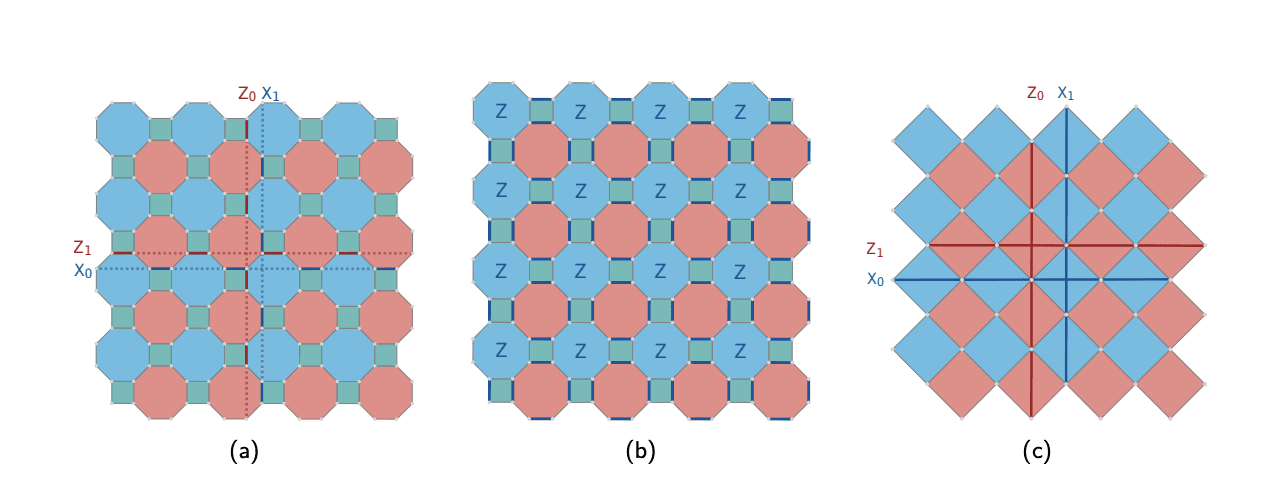
Quantum error correction (QEC) is essential for building scalable, fault-tolerant quantum computers, and unlocking the projected $1 trillion quantum computing market.
A new paper from researchers at Nu Quantum explores how logical quantum operations (or ‘gates’), can be implemented on a novel class of error correction codes.
This is an essential step towards realising the toolkit of a universal gate-set, and can unlock the path to an efficiently realisable, scalable, and fault-tolerant quantum computer.
What is a quantum gate?
A quantum gate is a basic quantum circuit operating on a small number of qubits. Quantum logic gates are the building blocks of quantum circuits, like classical logic gates are for conventional digital circuits.
The challenge of distributed quantum computing
Distributed quantum computing is a paradigm where multiple processors are interconnected to create a larger, more powerful computer. However, how to run logical computing operations on this type of computing architecture has been largely unexplored.
Building on Nu Quantum’s previous research into Floquet codes
Last year, Nu Quantum published a paper demonstrating the viability of ‘Floquet’ codes for this distributed model, revealing how this family of QEC codes are well-suited to architectures with sparse, long-range connectivity, and can offer efficient physical-to-logical qubit ratios.
In their latest paper, Nu Quantum scientists have advanced this work further, showing for the first time how a useful set of logical quantum gates can be implemented on these Floquet QEC codes.
Key findings: three logical gates successfully implemented
The paper indicates that three members of the logical gate set family (Hadamard, S and C-NOT) can be implemented robustly. The paper signposts the way to further work that can extend the functionality of the implementation, towards a Universal logical gate-set on Floquet codes. Furthermore improvements in efficiency (physical to logical qubit ratio) can be explored through, for example, support of (semi) hyperbolic Floquet codes.
This paper is an important contribution to the vibrant body of QEC research that is essential in the endeavour to deliver societally-useful Quantum Computing.
“This exciting achievement opens the door to logical gates on Floquet codes, marking an important step towards quantum logic viable on distributed architectures. This work strongly underwrites Nu Quantum’s vision for modular, interconnected quantum computers as the path to scaling towards fault tolerance,” says Dr Claire Le Gall, VP Technology at Nu Quantum.
“This paper is an important step towards making Floquet-code based schemes computationally complete. By adapting fold-based techniques for logical H and S, and Dehn-twist style ideas for logical CNOT, the authors provide a practical toolkit for logical operations on Floquet codes and back it up with clear numerical evidence of robust performance close to a memory baseline.” say Dr Arpit Dua; Principal Quantum Scientist at QuEra, Assistant Professor in Physics at Virginia Tech
What next ?
This research paves the way for the development of a universal gate set for Floquet codes, and signposts a path towards higher efficiency hyperbolic codes that will ultimately enable quantum algorithms to be run on distributed architectures, accelerating the timeline to fault-tolerant quantum computing.
This theory work also compliments Nu Quantum’s hardware roadmap for distributed quantum computing. This includes the development of Qubit-Photon Interfaces that enable quantum processors to be connected to a photonic network with high efficiency, and Quantum Networking Units that facilitate light-based quantum entanglement links between processors to create a networked computing architecture.
“Logical gates on Floquet codes via folds and twists,” can be read in full here: